

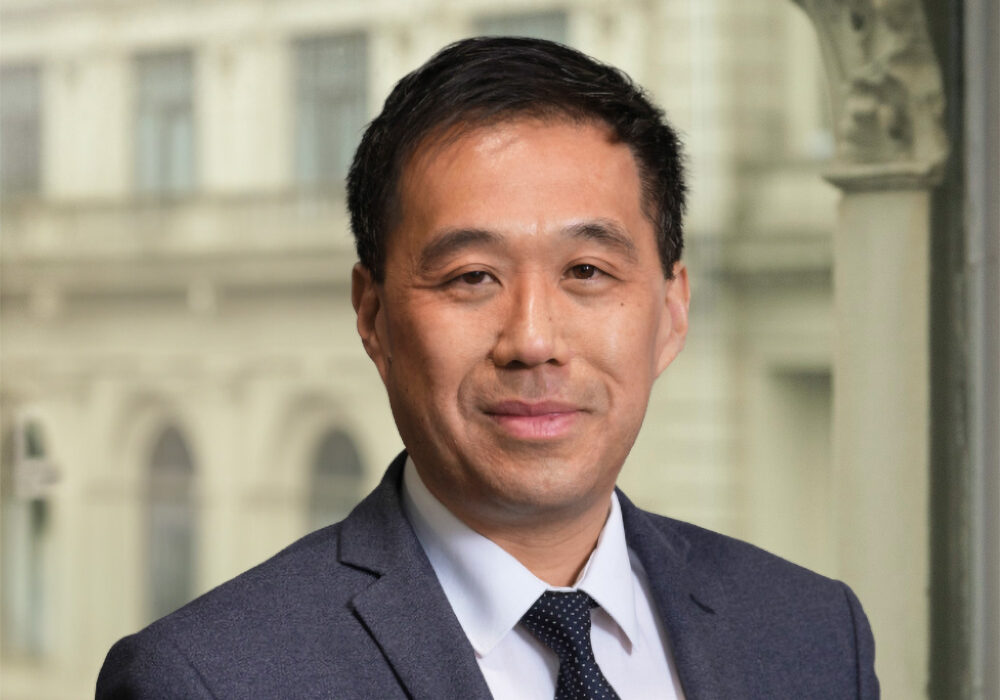
Scotland remains a “welcoming environment” for Chinese investment in areas including manufacturing, renewable energy and life sciences, with the country’s “exceptionally talented people and exceptionally great universities” making it an attractive destination, a leading legal adviser to Chinese businesses has said.
Speaking to Scotland China Brief, Harper Macleod partner and China desk lead Stephen Chan acknowledged the political scrutiny associated with Chinese investment, but said the UK’s national security investment regime was working well and enabling investments with significance to the Scottish economy to go ahead.
China expertise
While China transactions represent just a small part of the firm’s international M&A work, Harper Macleod has carved out a reputation as an experienced and reliable partner for Chinese businesses, recognised two years ago as a finalist in the Professional Advisory of the Year category at the 2024 China-Scotland Business Awards.
The firm’s China desk draws together colleagues on the corporate side – like Chan, who outside of M&A is recognised as an authority on Scottish partnership law and contributes on the subject to the Stair Memorial Encyclopaedia – as well as across the immigration, employment and real estate teams.
“If you’re going to have a factory, for example, there will always be a premises, you’ll have commercial and regulatory, IP – there’ll be a whole gamut of legal services that will be required,” Chan explained.
“The corporate team has a heavy focus on international work emanating from all over Europe, USA and Asia, so China is a part of what we do, but it’s not all we do,” he added.
That level of experience across a broad range of jurisdictions gives the team a high level of insight into dealmaking. “It’s a bit of a cliché, but the way you run a transaction in the UK is very different to how you run a transaction in the US, and very different from how you run a transaction in China.
“Things like how you negotiate, the manner you negotiate, clients’ expectations – in the UK, you would have your lawyers sit around a table and agree points, but in some jurisdictions, that might not be the norm.”
On areas relevant to the Chinese side of transactions, from navigating China’s capital controls to managing the logistics of transferring money internationally, the firm has learned to work collaboratively with Chinese law firms, including many of those in the ‘Red Circle’, China’s answer to London’s Magic Circle.
An increasing number of these Chinese firms now have London headquarters, allowing Harper Macleod to build strong informal relationships “on a face-to-face basis”, Chan said.
Sanctions, AML and national security
Alongside the firm’s expertise is its commitment to robust due diligence, going “above and beyond” statutory and regulatory requirements. “Because international transactions can often involve additional regulatory and compliance considerations, we tend to take a particularly thorough approach to due diligence,” Chan explained. “For example, we may carry out sanctions screening on all beneficial owners, even where it is not strictly required.”
Press coverage of Chinese investment in the UK has been defined in recent months by the furore over the Labour government’s decisions to block Ming Yang Smart Energy’s proposed £1.5 billion investment in the Scottish Highlands and to nationalise Jingye Group-owned British Steel’s operations in Scunthorpe.
Chan suggests looking at these high-profile stories as “just two cases in two specific areas”, which have not dramatically undermined the “welcoming environment” for foreign investment. Energy in particular is one of the 17 sensitive areas of the economy governed by the UK’s National Security and Investment Act, which doesn’t automatically capture investment in, for example, the UK’s healthcare or automotive sectors.
But the NSIA regime – which will soon mark its fifth birthday, having come into force in January 2022 – does not block investment in sensitive areas either. “I’m quite positive on the NSIA, which just introduced a set of rules for investment – and maybe it’s because I’m a lawyer, but I like definitive rules,” he said.
Government plans to amend the relevant regulations, in particular to cover acquisitions in the water sector and to create new categories for semiconductors and critical minerals, inevitably reflect the “new hot topics” of the day.
Harper Macleod has helped UK, US and Chinese businesses to successfully navigate the notification and call-in processes. In one case, Chan recalled having to explain some of the ins-and-outs of the UK’s constitutional setup to a Chinese client who asked whether “the lady in Scotland” was responsible for deciding applications – meaning then First Minister Nicola Sturgeon. “I had to tell them about the Scottish Government and the UK government.”
“If you have a foreign investor taking their technology to Scotland to teach us how to do things better, and it creates more jobs… then that is good for the country.”
Scotland’s need for investment
Scotland consistently ranks as the UK’s top destination for foreign direct investment (FDI) outwith London, for instance in EY’s latest UK Attractiveness Survey. Chan attributes Scotland’s appeal in no small part to the “deep talent pool” produced by the country’s “great schools and great universities”.
Against a backdrop of global economic uncertainty, he pointed out that Scotland has much to gain from investment from around the world, including China. “We need more investment into the UK… I go to lots of conferences where one of the issues in the Scottish economy is a lack of scale of investment,” Chan said.
“There’s lots of great businesses in Scotland, lots of very talented people who’ve created and invented things. They’ve got lots of help in Scotland to get them to the first level, but there’s a recognition that more needs to be done to get them to an almost unicorn status, and that’s where investment can help.”
The type of investment matters, of course. “What you want is investment where the jobs and the work stays in Scotland and it produces more opportunities for people in Scotland. If you have a foreign investor taking their technology to Scotland to teach us how to do things better, and it creates more jobs… then that is good for the country.”
Organisations such as Scottish Development International (SDI) are playing a constructive role, Chan acknowledged. “There’s various organisations that do a very good job of selling Scotland around the world – there just needs to be more of that to get more investment into Scotland.”
Key as well are the professional advisers, including from firms like Harper Macleod, who play an important and less visible role in bringing deals to fruition.
What would Chan look for in a young, outward-looking Scottish lawyer seeking to play such a role through their career? “I would want them to have not just great technical knowledge, but also knowledge of world affairs and current economic times… What clients are looking for – not just Chinese but any clients – is a lawyer who can also understand all the non-legal aspects of the transaction.”
Enjoyed this story?