

Key points
- Pressure from Brussels for UK to raise import duty on Chinese EVs to match EU tariffs
- UK government hesitant as retaliatory tariffs could affect Jaguar Land Rover and Nissan
- Experts suggest UK should instead focus on courting Chinese firms to build local factories
Mooted UK tariffs on Chinese-made EVs are likely to have a “marginal” effect, a prominent authority on the Chinese car industry has told Scotland China Brief.
The UK government has authorised officials to draft potential tariffs on Chinese electric vehicles (EVs) as pressure mounts from the EU, as the trade bloc is advancing its Industrial Accelerator Act to prioritise its own industrial development over Asian imports. Brussels now imposes levies of up to 45% on Chinese EVs, and has warned Prime Minister Andy Burnham that the UK must align more closely with EU trade policies or face punishing “Made in Europe” trade barriers.
Mark Andrews, author of Driving the Dragon: The Rise of the Chinese Car Industry, believes that whilst reviewing the situation is necessary, duties may ultimately prove ineffective.
“With Chinese brands dominating UK car sales in September, consideration of such a move is inevitable,” Andrews noted. “However, as the EU case has shown, their effect has been marginal, with Chinese brands simply switching to PHEVs, ICE or manufacturing within Europe to circumvent the tariffs. That said, China has used tariffs for years to stem the tide of car imports and to force OEMs who wanted access to the market into JVs. This helped create what became the now world-beating EV manufacturing ecosystem.”
The UK currently maintains a standard 10% import duty. Any additional UK measures are for the time being “under review”.
Business secretary Jonathan Reynolds has stopped short of green-lighting tariffs to avoid provoking reciprocal measures from Beijing. Such retaliation would damage export-reliant UK automotive companies, such as Jaguar Land Rover.
“Our core interests are slightly different to the EU as a whole as we are an export-led industry,” Reynolds explained at the recent Labour conference. He stressed that imposing tariff barriers only to lose crucial global market access would mean “you’re not gaining”, though he promised to act if the balance of interests shifts.
The domestic car industry itself lacks a unified stance. While Nissan’s European chief, Massimiliano Messina, recently warned that the UK risks becoming a “corridor” for Chinese EVs, the Japanese manufacturer is simultaneously negotiating with Chinese group Chery to build cars at its Sunderland plant.
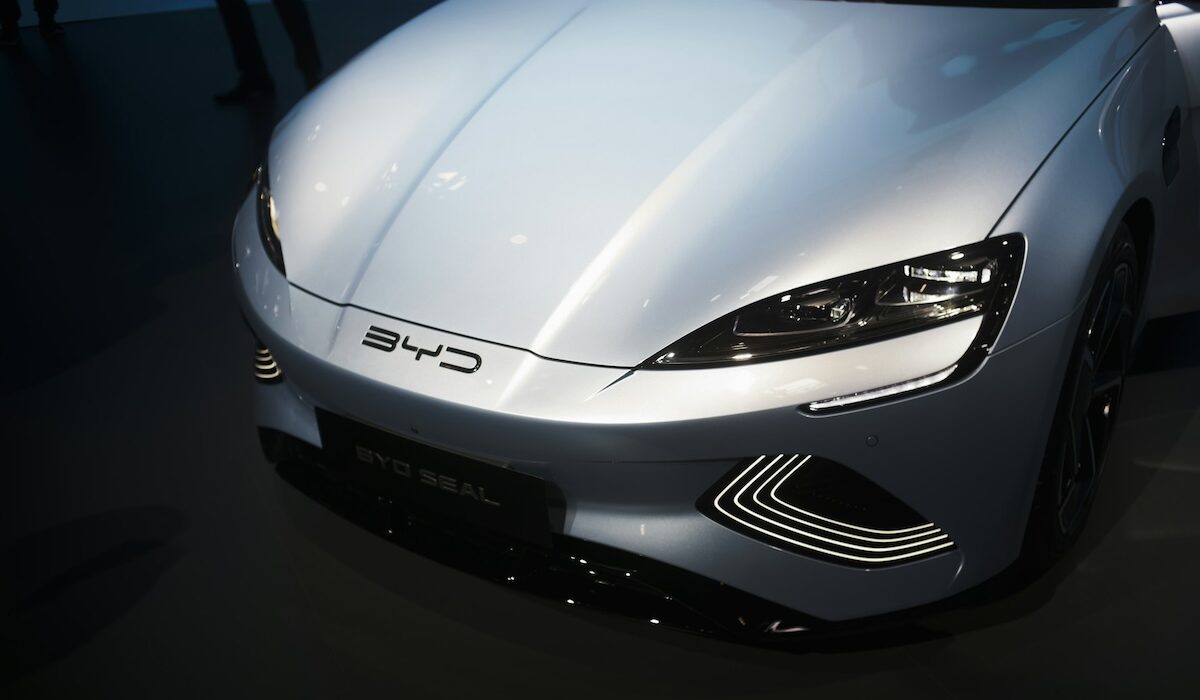
Meanwhile, Chinese vehicles are rapidly gaining a foothold. Brands such as BYD, Chery, and Geely accounted for more than 20% of new UK EV sales in September alone, with the Chery-owned Jaecoo 7 becoming the UK’s best-selling model.
In Scotland, Arnold Clark has been expanding its partnership with Chinese EV brands. It recently opened its first two Geely branches, and has started selling Chery-owned Lepas EVs at six locations across the country.
Enjoyed this story?