

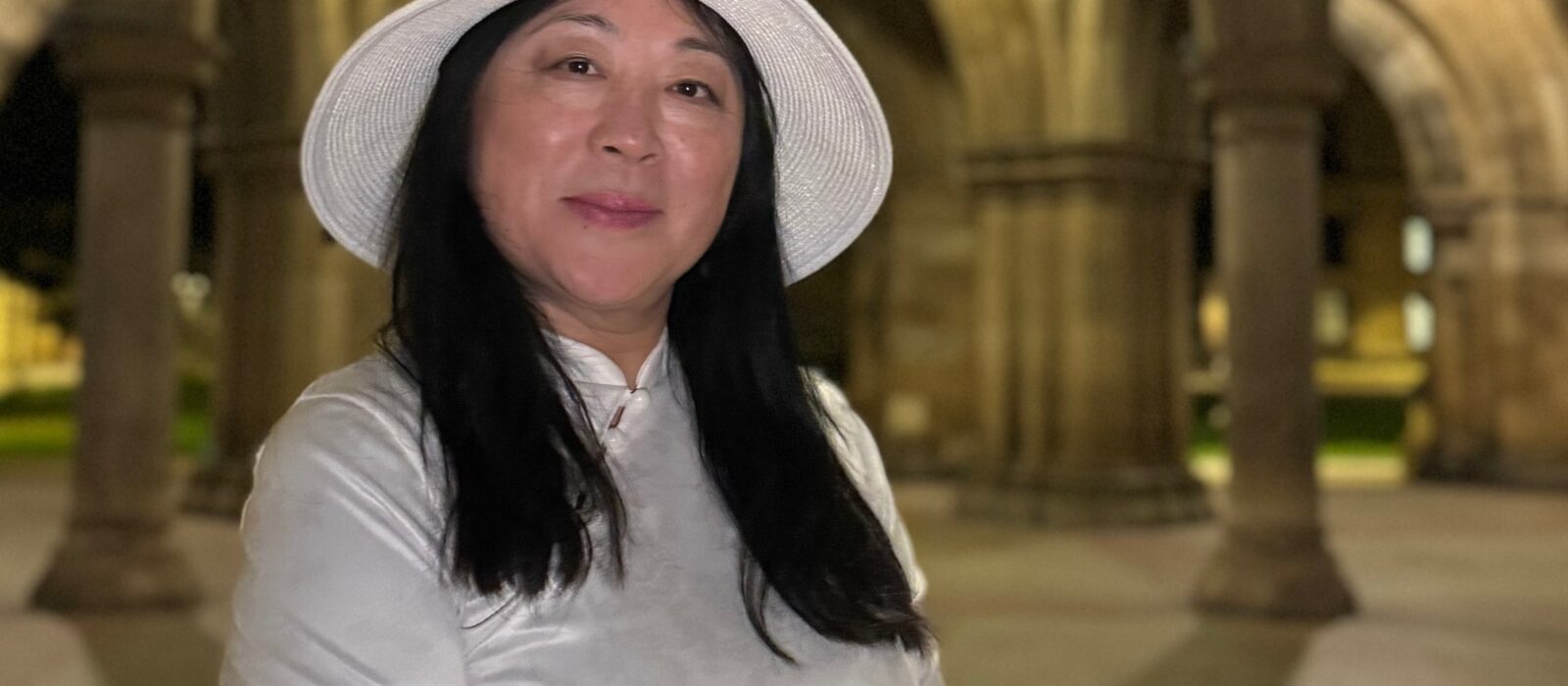
Chinese American author and filmmaker J.J. Cheng 程一若 (程娟) has spent this summer in Scotland retracing her grandfather and his brother’s century-old journey to the country, uncovering a little-known chapter of history that contributed to China’s early modernisation.
This month, J.J. Cheng walked out of the University of Edinburgh’s archive holding a record she had spent a decade looking for – her granduncle’s graduation, a Master of Arts in economics. Cheng Zhenji came to Glasgow with his brother Cheng Zhenjun in the summer of 1913, having survived a perilous journey via the Sabria train, and later began his studies in Glasgow as an engineer.
Speaking to Scotland China Brief in an Edinburgh café, she was still turning over the record she had uncovered. “These two brothers,” she said, “one is really focusing on science” and the other, it now seemed, had walked away from engineering towards finance, trade and business.
The two brothers are Cheng Zhen Jun (程振鈞, 1888–1932), known by his courtesy name Taofu, and Cheng Zhen Ji (程振基, 1890–1940). Between 1910 and 1919 they, and a third relative, Yu Hu (1894–1959), studied in Scotland. They appear in the University of Glasgow and Royal Technical College (University of Strathclyde) registers under the romanisations of their day – Cheng, Tsen Kun; Cheng, Chen-Chi; Yu, Hsi Yu 俞忽 – which is one reason their names have been effectively invisible to English-language researchers for a hundred years.
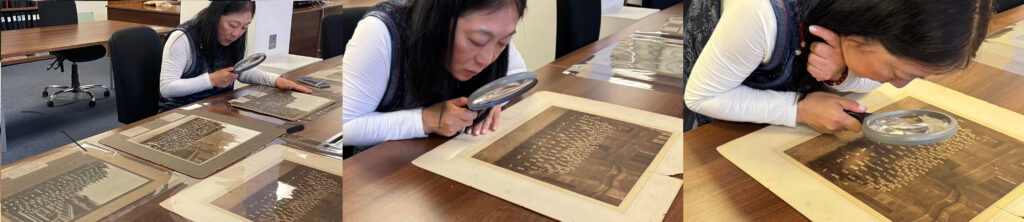
Their descendant, an award-winning Chinese American author, filmmaker and former CCTV English-language broadcaster, now based in New York, has spent this summer in Glasgow and Edinburgh trying to make them visible again. And she is asking Scottish institutions to help her finish the job.
From an imperial examination hall to a Glasgow lecture theatre
Cheng Zhen Jun’s life reads as a compressed history of his country’s collision with the modern world. According to a state-archived eulogy his granddaughter has recovered, he could recite the Four Books and Five Classics from memory by the age of ten, and at sixteen he sat one of the last imperial civil-service examinations before the system, thirteen centuries old, was abolished in 1905.
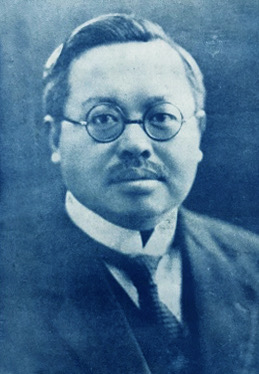
Four years later he left China. He sailed in December 1909 and reached London on 22 January 1910 after thirty-eight days at sea, then travelled north to Glasgow to study civil engineering. He completed an associateship in 1916 and returned home that September.
Why Scotland? His granddaughter’s answer is that the Chinese intelligentsia at the time was well informed about where technical expertise lay. “Britain was leading the world technologically,” she said, and Glasgow was the birthplace of industrialisation. She believes her grandfather was among the first Chinese students to go there deliberately for that reason, possibly on the advice of his mentor.
That mentor, she says, was Yan Fu (嚴復) – the translator who brought Huxley, Smith and Mill into Chinese and reshaped how a generation of reformers thought. She has been told by historians in several Chinese cities that Cheng Zhen Jun was among his outstanding students. It is a claim she is still documenting, but it reframes the Scottish chapter.
“I believe my grandfather learnt not just civil engineering techniques,” she said. “He must have been influenced intellectually, emotionally, about a new way of thinking.” She is emphatic on this point, and returns repeatedly to Adam Smith’s moral philosophy alongside James Watt’s engineering. She has come to Scotland, she says, partly to say thank you to these thinkers.
What they built
The clearest surviving monument to Cheng Zhen Jun’s Scottish training is not a bridge but an exposition.
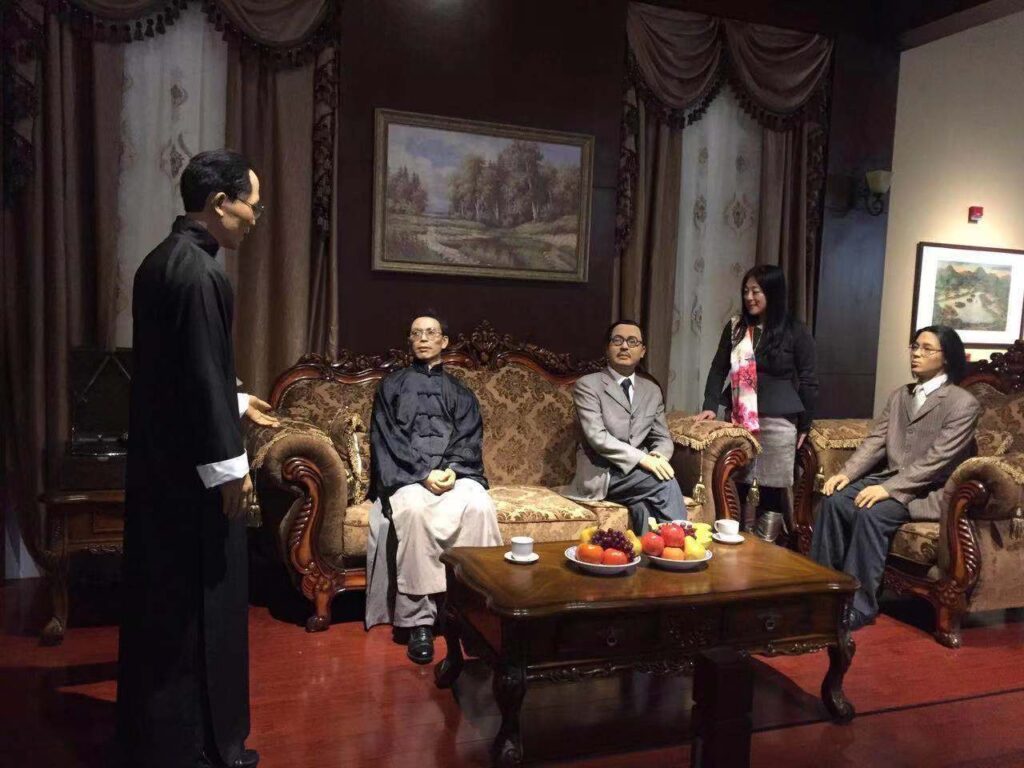
As head of the Zhejiang provincial construction department, he chaired the preparatory committee formed in October 1928 to organise the first West Lake Expo, and served as its vice-president under the provincial governor Zhang Jingjiang. The committee assembled more than six hundred specialists and gathered close to 148,000 exhibits. The exposition opened at Hangzhou on 6 June 1929 and ran for 137 days, drawing more than twenty million visits – a scale that made it, in its moment, China’s answer to Chicago and Philadelphia.
It was not held again for seventy-one years. Revived in 2000, it now runs annually, and its centenary falls in 2029.

Cheng Zhen Jun is also credited with the highway that opened in 1933, a year after his death at forty-five, and with teaching at Peking University, Jiao Tong and elsewhere. He returned to Glasgow in June 1930 at the head of a Chinese delegation on a nine-country tour surveying Western industrialisation – a trip documented in photographs his granddaughter has assembled and which have not previously been published.
His younger brother took the other road. After Edinburgh, Cheng Zhen Ji returned to found what his family describes as the first local private bank in their home region, his name printed on its notes, and worked to open export routes for Chinese tea. Between them, his granddaughter argues, the brothers laid two halves of a single blueprint: infrastructure and industry on one side, finance and commerce on the other.
Why nobody knew
None of this was passed down. Her father, Cheng Zhesheng, the youngest of five sons, died in 2007 without telling his daughter where the family came from.
The reason was survival, as during the Cultural Revolution a scholarly, Western-educated, property-owning lineage was precisely the kind of inheritance that could destroy a household, and a child who repeated it at school could be lethal to her own parents. Silence was protection, and it outlasted the danger.
She left China in 1988 and spent three decades in the United States. It was 2015 before the past surfaced – twice over, and by accident. Sorting her father’s papers, she opened a drawer and found a handwritten account in his hand, written in what she calls a confessional style. Around the same time, a classmate mentioned at a reunion that her family had once owned a courtyard house in a prime part of Beijing. She went to look for it, walking a street where the numbering had been changed, trying to work out which door had been hers, until people asked her what she was doing there.
“I want to know who my ancestor is,” she said. “That is the starting point for me.”
Looking forward
Ten years of research followed, across Taiwan and ten cities in China, with a number of historians she now coordinates with. Scotland was left until last, and she describes it as the most important piece.
Now she is searching for local partners, including a Scottish cinematographer and Scottish production support for the documentary, because a film about a shared heritage made entirely with a Chinese crew would not, she says, be a shared heritage film. She wants university history departments, cultural offices and external-relations teams to search their own records alongside her. She wants museums and galleries interested in an exhibition, chambers of commerce interested in the trade and tourism dimension, and a funding body willing to treat this as a story worth investment.
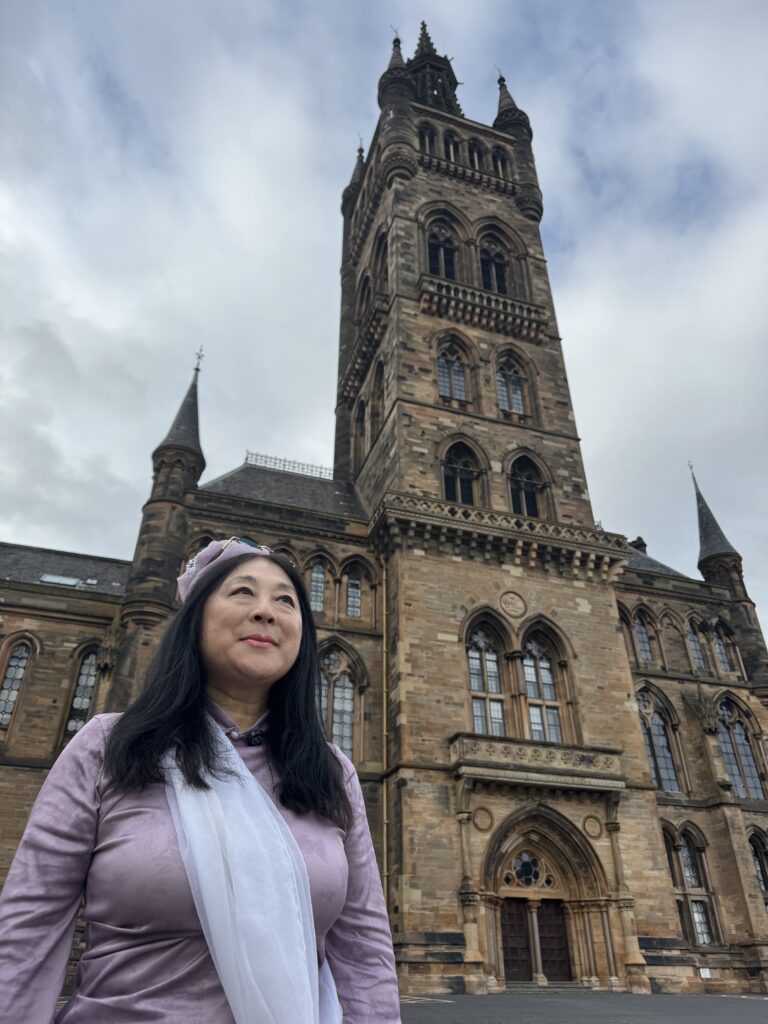
Above all she wants something that recurs – a heritage programme bringing students and teachers back to this material year after year, rather than a single commemorative event. “History is really a bridge,” she said. “I single-handedly cannot do it.”
There is a deadline of sorts. If the centenary of the first West Lake Expo in 2029 is to carry a Scottish component, the work of building it starts now.
J.J. Cheng is publisher of East-West Corridor Press and author of PHOENIXA: THE NEST, winner of a 2026 Nautilus Book Award Gold. The Cheng Legacy documentary and book project launches at chenglegacy.com in 2027.
More details can be found at phoenixacheng.com and J.J. Cheng can be contacted at chengpress@gmail.com
Enjoyed this story?