

Key points
- China’s expanding middle class and food quality focus drives demand for premium imported seafood
- Since 2018, CFSE has more than doubled in floor space to become a major global trade show
- Succeeding in the Chinese market requires adapting to local business practices
Coinciding with this week’s 2026 China Fisheries & Seafood Expo in Qingdao, Phillip Quirie discusses local trade insights from the British Consulate-General in Shanghai and along with his own eight years of experience in the sector, outlining why Scottish seafood exporters should consider exporting to China and how to access its evolving market.
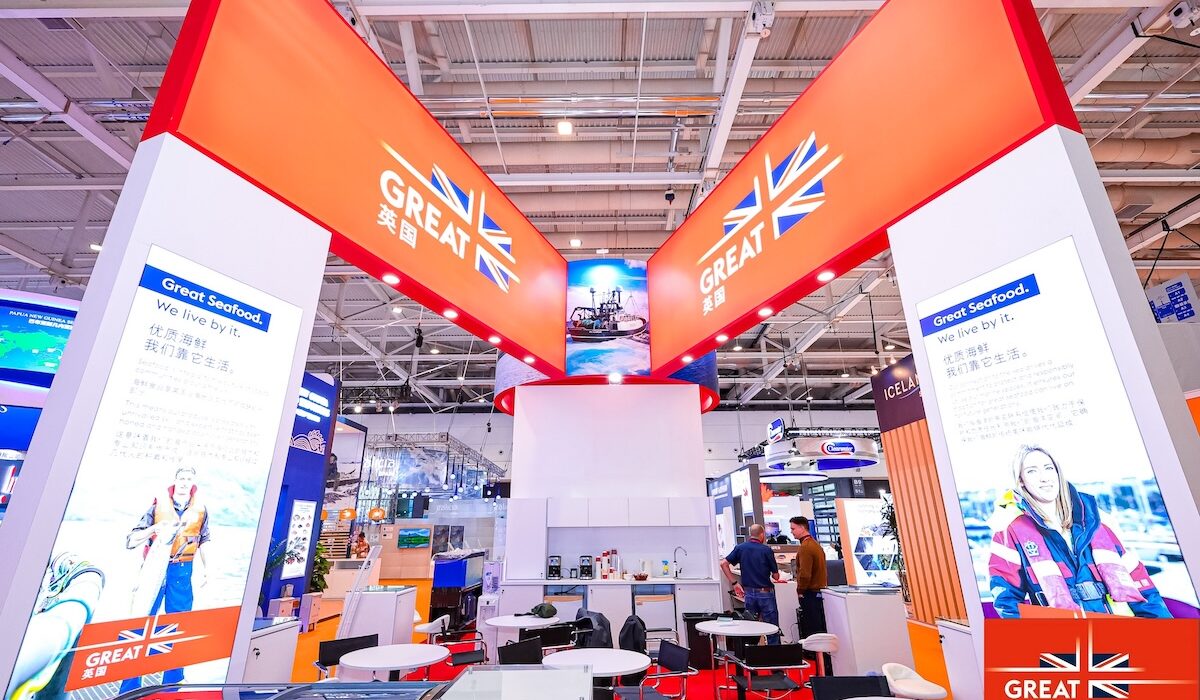
The 29th edition of the China Fisheries & Seafood Expo (CFSE) takes place at the Hongdao International Conference and Exhibition Centre in Qingdao, China, on the 28th to the 30th of October 2026. We’re working with our government sponsors, Defra, to deliver another United Kingdom seafood pavilion, comprising of a live chef demonstration kitchen and sampling area, and dedicated company exhibition podium desks with tables and chairs – perfect for meeting customers and attracting attendees.
Why should you exhibit on the UK pavilion? It’s a good question. Instead of us telling you why, we also asked someone else. Someone with an interest in seafood. Someone with expertise in trade, commerce, and market patterns in China. Someone discerning. Someone who lives in China. Someone who is from China. An insider. That someone is Dakota Du, who is the Senior Trade & Investment Officer at the British Consulate-General in Shanghai, and here’s her “Insider’s Five” reasons to consider doing so.
- Scale and demand
China remains one of the world’s largest seafood markets, with a large and increasingly sophisticated consumer base seeking premium, safe, and high-quality seafood products. - Growing appetite for premium quality imported seafood
Chinese consumers continue to value imported seafood for its quality, provenance, sustainability credentials, and food safety standards, creating opportunities for trusted international suppliers. - Premiumisation trend
As incomes rise, consumers are increasingly willing to pay more for premium and differentiated seafood products, particularly through retail, hospitality, and gifting channels. - Multiple routes to market
From traditional importers and distributors to e-commerce platforms, retail chains, foodservice operators, and speciality seafood outlets, companies can access a wide range of sales channels. - Long-term market potential
Despite economic fluctuations, China’s large population, urbanisation, and expanding middle class continue to make it an important strategic market for seafood exporters looking for long-term growth.
Added to that, Dakota says there is a variety of species from the United Kingdom currently attracting interest, including:
- Langoustine (available in China)
- Brown crab (available in China)
- European lobster (available in China)
- Mackerel (available in China)
- Whelk (available in China)
- Scallop (not available in China)
- Cold-water prawns (not available in China)
- Monkfish (not available in China)
- Oysters (not available in China)
- Salmon products (available in China)
But it would be remiss of me to produce a blog without using the opportunity to convey some observations and thoughts I’ve gathered over the past eight years of supporting UK exporters at CFSE. My first time at the expo was in 2018 and since then I’ve witnessed palpable evolution of the expo and the Chinese market. Here’s my “Outsider’s Five” evolutionary observations.
- Growth and diversity of attendees
Since 2018 I’ve seen the expo grow exponentially in terms of exhibition space (2018: 45,000sqm of exhibition space, 2025: 115,000sqm) and visitor numbers (2018: 33,000 visitors, 2025: 45,279) which prompted a shift to a larger venue in 2023. Not only has the volume of visitors increased but so has the diversity. Erstwhile, the expo focused on China and surrounding Asian markets but now you can expect to meet buyers from all over the world, making CFSE a truly global show rivalling its Barcelona brother. - Greater awareness of the UK and our seafood
A vivid recollection from my first couple of visits to China was navigating my way through interactions (even with the aid of a translator) describing to visitors the geographical constitution of Great Britain and Northern Ireland and the variety and seasonality of our seafood. Audiences now apparently appreciate the characteristics and quality of UK seafood without the need for considerable descriptive dialogue. - The emergence of middle-class Asia
As incomes across much of eastern and southern Asia rise, so does socioeconomic classification and expenditure – the rise of the middle-class. This increase is noticeable even when walking the streets, with the middle-class using retail habits and food consumption as ways to visibly express their new wealth. Think designer labels tucking into premium imported seafood. - The growing prevalence of WeChat
Described as China’s “app for everything” due to its multi-functionality, WeChat provides text messaging, hold-to-talk voice messaging, broadcast (one-to-many) messaging, video conferencing, mobile payment, sharing of photographs and videos, and location sharing. It has been described as “an almost indispensable part of life in China”. All experienced exporters will be trading with China via WeChat and it’s become a core modus operandi of commerce and everyday life. And it can translate your English into Mandarin. - Price point is the bottom line for importers
Some Asian markets – most notably Japan and the Republic of Korea – involve an enduring process of gaining trust and loyalty before business is secured. The Chinese market differs from this – price point is the first thing an importer wants to know. China’s huge distribution network involves multiple layers (importers, regional wholesalers, sub-distributers and retailers). Importers must work backward from the final target consumer price to calculate a viable landed cost. If your price leaves no room for distributor margins, importers will opt to pass on the product. Lower international price points can actively unlock new demand, which is perhaps the antidote for businesses focusing on high volume rather than high value products.
We’ve produced a dedicated webpage providing guidance on how to export seafood products to China, including Chinese trade regulations and market access barriers: click here to visit
Phillip Quirie is industry engagement officer at Seafish.
Enjoyed this story?